Recent Posts

Menu
Powered by Blogger.

Browsing "Older Posts"

Browsing Category "Tips and Tricks"

Tips for Pitching Praise

Monday, May 5, 2014 / No Comments
Whether it's "Good Job" or "Way to Go" chances are you have a generic praise that routinely leaves your lips with little thought over the process.  All these phrases do is invite your child to work solely for your approval.  It's easy to find yourself in a pattern where you must use them more frequently.  Our children, desperate for our approval, often need more and more as they become dependent on our praise for satisfaction.


Ditch Your Generic Go-To Phrase
One of the biggest challenges faced in pitching praise is that our favorite go-to phrase becomes so second nature that we're rarely conscious of saying it.  Start paying attention to how you respond to your child.  You may be surprised at the sheer amount of praise you dish out in a day.  Once you're aware, you can start curbing the habit.  It's easier said than done but awareness is half the battle.

Make an Observation
If there something you would like to acknowledge, make an observation that is free of judgement.  Simply comment on what you see.  If your child completes a piece or artwork you could say, "I see you used a lot of green."  or "Look at all the flowers you drew."  You have thoughtfully acknowledged the work without negating their effort by shifting the focus to your approval.  As you begin to employ this approach, you'll find you can adapt it to nearly any situation.  For example, if you want to point out a positive action then you may say something like "Aunt Betty looked so happy when you gave her the card you made."

Focus on Effort
It's easy to get hyper-focused on results but for the child, it's the journey that matters.  Whether things go right or wrong in your eyes, make the effort the main conversation point.  "I can see that you worked very hard to recreate this map." Or "You completed the pink tower!"

Shhhhhhh
Always keep in mind that our children don't need us to comment on everything they do.  We live in a society that abhors silence; filling each moment with a distraction.  Sometimes it's helpful to stay quiet and let our children focus on their thoughts.  We can also use these opportunities to ask what was they enjoyed about the process.  "What did you like best about painting this picture?"  What a great way to honor the effort and get a deeper understanding of your child.

"Your turtle has spots!  What is your favorite thing?"


Removing praise from your interactions with your child can be difficult and takes time.  It's something that is often deeply ingrained in us.  However, if you are mindful of your words, you can make progress towards that goal each day.  Keep in mind that it may take time for your child to switch gears as well, especially if they have come to rely on the words of others for gratification.  Stick with it!  You will get there and it will be worth it in the end.

And if you missed our last post on the problems of praise, you can read it here.

-Bess


How I Got a Sensory Table for $5

Wednesday, September 18, 2013 / No Comments
If you've seen photos of the classroom, you've probably noticed the sensory table.  Yes, it's starting to show a bit of wear from years of water play but it's still holding up very nicely.


Our table began it's life as a standard end table.  I actually snagged this one for free from a roommate in college who may have pulled it from a dumpster.  I will neither confirm nor deny that story.

The part where the real magic happen, also called the tub, is a large sized dishpan that I purchased at the local big box store for less than $5.


You may be surprised at how easily it is to come across old end tables.  With any luck, a family member or friend will have one they would pay you to take off their hands.  If you do find yourself in the position to purchase one, check at yard sales or thrift stores.

You don't need anything special.  The most important aspect is that the tub you select can fit between the legs.  I have flipped the table over so you can see what I mean.  I suggest taking a tub with you while you table hunt.


Once you have found your table, simply trace the bottom of the tub onto the top of the table and cut it out.  It's important that you trace the correct side because it's the lip of the tub that will keep it from falling through the hole.  My father cut mine for me in less than 2 minutes.


Depending on the height of your table, you may want to trim the legs down as well.  We cut off a few inches to make it more height friendly for toddlers.


Then you simply drop in your tub and fill with goodies!  Here I have added green rice and animals from the grasslands to go along with our study of biomes.  I also like to lay out items to scoop and pour with.


I tend to stash the extra items on the shelf below.  The kids enjoy finding what I've hidden down there.  I placed my table on an old floor protector which helps with some of the mess.


As you can see, creating a standing sensory tub is relatively easy and extremely budget friendly.

And if you'd like to a quick tutorial on dying your own rice, check out this post from Mama Jenn.

Ten Tips for Buying Used Montessori Materials: Part III

Monday, August 19, 2013 / No Comments
This is the final post of a three part series titled Ten Tips for Buying Used Montessori Materials. We are looking at ways you can make the most of shopping for used materials on various online buy/sell groups.

Part I - Before You Join a Used Material Sale Group (Tips 1-4)
Part II - When You Find an Item You Need (Tips 5-9)
Part III -When You Find Something Intriguing You Don't Need (Tip 10)


What to do When You Find Something Intriguing You Don't Need

Yes, that's right.  We have one measly tip.  I'll try to make it good.

10.  Refer Back to Your Plan
As much as you can plan for the items on your "needs" list there will always be a number of unexpected extension items that pop up from time to time.  It can be hard to make a sound decision in the heat of the moment when you know how fast things sell.  These can turn out to be great enhancements to learning or space-wasting drains to your budget.  So how do you know which is which?

Hopefully you have taken the tips in Part I serious.  If so, you're well on your way to making a sound decision.  The first consideration is budget.  Your "needs" list is always your first priority.  If you don't have the money then don't buy it.  But again, this means that you have taken the time to know your limits and to understand where you're at with your budget at any given point.

The other aspect, also discussed in Part I, is determining if the item fits within your identified needs.  There is an endless parade of fabulous extensions, each with something unique to teach your child.  The reality is that you don't need them all.  In fact, you can't even use them all in a reasonable time frame.  I would double that statement for extensions aimed at the toddlers.  Before you commit, ask yourself when and how you plan to use the item.  If you can't answer definitively, move on.  An extension concerning the lifecycle of butterflies is a wonderful addition if you have already planned to raise live butterflies.  On the other hand, a puzzle map of a France may not be a good investment if you weren't already planning to delve into that country; especially if purchasing it meant sacrificing a puzzle map of Europe or the continents.  While most materials are good for everyone you need to focus on what is best for your particular plans.

And of course, the standard considerations apply here as well.  Is the item complete, in reasonable shape, acceptable in quality and priced well?  Does the material even line up with Montessori principles?  I realize that may sound like an odd question but keep in mind that anyone can call anything Montessori.  The name is so popular today and many individuals don't truly understand the characteristics that a Montessori work should exhibit.  Yes, I have seen things listed that are actually contrary to the method.

There is no exact science in this area so do your best to remain levelheaded.  Chances are if you see a logical reason to pass you will eventually be glad you did.


And that concludes our three part series.  I'd love to hear your experiences with buying used materials.

Ten Tips for Buying Used Montessori Materials: Part II

Friday, August 16, 2013 / No Comments
This is the second part of a three part series titled Ten Tips for Buying Used Montessori Materials.  We are looking at ways you can make the most of shopping for used materials on various online buy/sell groups.
Part I - Before You Join a Used Material Sale Group (Tips 1-4)
Part II - When You Find an Item You Need (Tips 5-9)
Part III -When You Find Something Intriguing You Don't Need (Tip 10)

What to Do When You Find Something On Your List

5.  Move Fast
While always connected smart phones and alerts on new listings are immensely helpful, it has only increased the competitiveness of a very limited market.  I have seen good listings claimed in less than a minute; sometimes so fast that by the time I refresh the page to view the listing, it's already spoken for.  There isn't time to dawdle with the good listings which is why going through the planning steps (tips 1-4) is so critical.  Without planning your only option is to jump blindly, not knowing if what you see is even a good deal or something you truly need.  Unfortunately, there simply isn't time to research and contemplate when an item is listed.  Of course, some listings do linger on and on.  Unless it's something highly specialized, I'd ask myself why because good listings never last.

6.  Ensure You Understand the Full Price
Most sellers do not include the price of shipping in the offer.  Keep in mind that most traditional Montessori are heavy and often oddly shaped.  The average individual seller does not have access to the same large volume shipping discounts as major retailers.  You can expect shipping to start around $8-$10 (continental US) for the average sized wooden works.  That can quickly climb to $20 with a larger one.  The more materials you add the more it will cost.  Obviously, if you order from an International seller, the rates will increase exponentially.  There will be a cost for shipping if you order from a discount supplier as well.  However, these are generally lower and may even be free depending on how much you order.  Consider whether or not you plan to place an order soon.  It may be cheaper to add a slightly more expensive product to an existing order than to pay for another shipment from an individual seller.

7.  Be Realistic About the Condition
The wonderful thing about traditional Montessori materials is that most of them hold up extremely well with use.  However, used it still used.  Chipped paint is one thing.  Missing pieces are another.  Many of the traditional materials have small pieces that are easily lost such as the top cube of the pink tower or the smallest of the knobless cylinders.  Sellers generally discount items accordingly so it makes such a purchase attractive.  In some cases you can acquire replacement parts from the manufacturer but this becomes more difficult with certain direct-from-overseas suppliers.  Even though materials are fairly universal it doesn't mean that replacements match from one company to the next.  And of course, replacements have a cost both for the item itself and shipping that take away from the deal.  Before proceeding in such a case, find out who the manufacturer is and determine what your options are.  Most Montessori materials are designed with a great attention to detail.  A missing piece will most often remove all control for error.  Try to avoid the temptation to buy something incomplete just so you have it.  

8.  Consider The Quality
As the popularity of the Montessori Method has increased, so have the fly-by-night manufacturers.  Premium suppliers such as Nienhuis and Gonzagarredi produce materials with unparalleled quality and the price tag to match.  Discount suppliers such as Alison's Montessori and Montessori Outlet use less expensive base materials but still provide appropriate safety testing.  Direct from overseas products are similar to those of other discount suppliers but due to their distribution routes, they are generally not adequately safety tested for children.  If your new item has a terrible chemical smell, that's a high VOC level.  Yes, it's dangers for children.  If that has been overlooked then I can't help but wonder what other safety aspects have been overlooked.  Bonus tip for the US crowd...  look for a discount supplier that is a legitimate, long-standing business with a physical location in the United States and a working phone number.  It doesn't guarantee you'll avoid the issue but it helps.

With that said you may feel that only buying from premium suppliers is best.  Unless you are equipping an actual school where the item will see numerous sets of hands it probably isn't necessary.  While Nienhuis products are beautiful, the price of a used item often far exceeds the cost of buying the discount version from a reputable supplier.  Obviously, if your budget allows then go for it.  On the flip side, don't automatically jump at every discount piece you see.  Ask the seller to disclose the original manufacturer.  Then you can make the decisions as to whether or not that company has a safety record you are comfortable with.

9.  Examine Potential Risks
If you participate in any of the major Montessori buy/sell groups then you'll notice that there is a disclaimer letting the buyer know that the group is not responsible for the outcome of transactions.  As a buyer you are essentially on your own.  There is no one to help ensure you get what you paid for in the condition described and time frame agreed upon.  Depending on how the transaction is carried out, you may have little recourse if something does go wrong.  One of the biggest tips I can give in this area is to pay for your purchases via PayPal.  You are protected by Paypal's services and can file a dispute should something go wrong.  Be very leery of any seller that requests cash or other less traceable payment routes.  And NEVER give your credit card info.  There's no good way to know an individual seller's reputation on online groups so buyer beware.  And unfortunately, even an honest individual may not know to adequately pack something for shipping.  If you have questions about any aspect of a material or how the transaction will occur, ask up front.  Incorrect assumptions are a great way to ensure you'll be unhappy with the end result.


Part III will conclude our mini-series.  We will look at what to do when you find something intriguing but it isn't on your must-have list.

Ten Tips for Buying Used Montessori Materials: Part I

Thursday, August 15, 2013 / No Comments
Given the cost of implementing Montessori, joining the various used curriculum online groups is tempting.  While many individuals have found great deals, not all listings are worth your limited budget.  Over the next three posts I will share ten tips for making the most of the used Montessori material market.

They will be divided as follows:
Part I - Before You Join a Used Material Sale Group
Part II - When You Find an Item You Need
Part III  -When You Find Something Intriguing You Don't Need

1.  Decide What You Need
My number one tip is also THE most critical piece of advice I can give.  When you are newer to Montessori, it's easy to think, "Well, I need everything" and simply start trying to purchase anything and everything you can get your hands on.  Stop and get a plan.  I know how enticing Montessori is.  It's hard to learn about something so amazing without wanting to reorganize your house that very day.  Take the time you need to get your mind around it.  Everyone will be far better off if you take a month or two to understand what you need, why you need it, and how to present it correctly.  And until you take this critical step, your impulse buying will run you in circles.  And a bonus tip... your most critical purchase is your albums.

2.  Determine When You'll Need It
Montessori is grouped in three-year age spans.  This means that some materials may not be needed for two full years.  And of course, if you are only planning to home school up until Kindergarten (and no, I won't give my lecture on the importance of the final year) then there are some you will not need at all.  Become familiar with the order of presentations in your albums (scope and sequence).  Focus on the items you need in the immediate future (6-8 months).  Yes, it's tempting to jump on a great deal for something you'll need in a year or two, but keep in mind that if your budget is limited, then you may be robbing yourself of something you need today.  

3.  Estimate Cost Plus Shipping from Discount Suppliers
I can't tell you how many times I've seen a used Montessori item sell for twice what I paid for mine new even before shipping.  In fact, it happens on a regular basis.  Get to know the market for supplies from reputable discount suppliers.  I know I've mentioned before that Alison's Montessori is my favorite for a host of reasons (check the Bargain Basement).  It's also important to add shipping into the equation because it varies vastly with each supplier and will make an impact on your bottom line.  I highly suggest keeping a general price list alongside your wish list.  Then it will be easy to see just how good of a deal you're really getting.

4.  Realistically Face Your Budget Constraints
It's easy to find yourself in a money pit with any method of home schooling, although Montessori tends to get you there faster than most.  It's important to understand what you can spend before you spend it.  As I mentioned in tip number two, the most critical items are those you will need in the near future.  Knowing your limits will help you focus your resources on the important things and ensure impulse buys don't unexpectedly dominate your spending.  And of course, don't forget that your school experience will cost more than just the materials.  Don't forget to add other incidentals such as office supplies, basic consumables and general needs.  Printer ink, colored pencils and work trays aren't free!


Stay Tuned for Part II - When You Find an Item You Need

Making the Most of the Yard Sale Season

Thursday, June 13, 2013 / No Comments
While the older children enjoy their Montessori summer school experience, the little guy and I spend our Friday mornings tracking down yard sales.  In our area, it is common for neighborhoods to host community sales which are my favorite since I can park in one spot and walk from sale to sale.

It can be easy to overlook the usefulness of yard sales when constructing a Montessori environment.  Chances are you are never going to stumble across a pink tower or box of golden beads.  However, there are some key things I always look for and can generally find to some degree on every outing.  The trick is to understand what to look for.  Often the things I get most excited about aren't the goods that thrill the average yard sale attendee.

General Work Setup
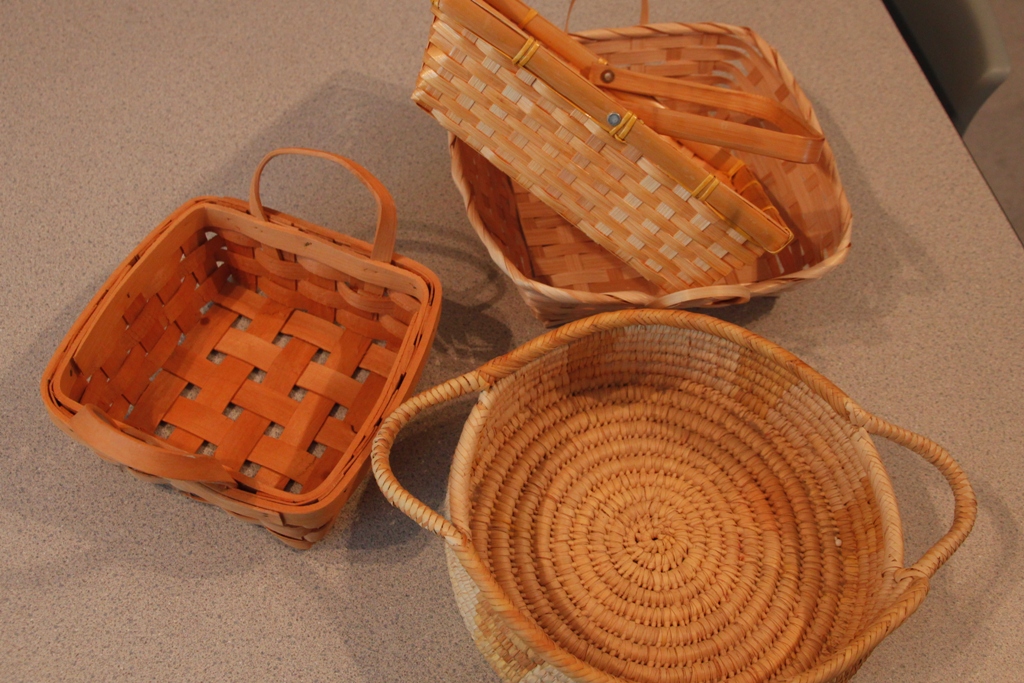
What would a Montessori classroom be without baskets, trays, bins and other items for setting up works?  Not only do I spot these items at every outing, I often spot them at every house I visit.  I find my biggest challenge is deciding what to purchase, given the overabundance of options.  Always keep in mind that these items must be manageable for a child.  Trays and baskets should be light and appropriately sized.  While I use a few baskets with handles in the classroom, I find that those without fixed, upright handles are the most versatile.  
Baskets I purchased from a recent yard sale outing.  I paid $1 for all four.  The circular one was hand woven in Ethiopia.

Books
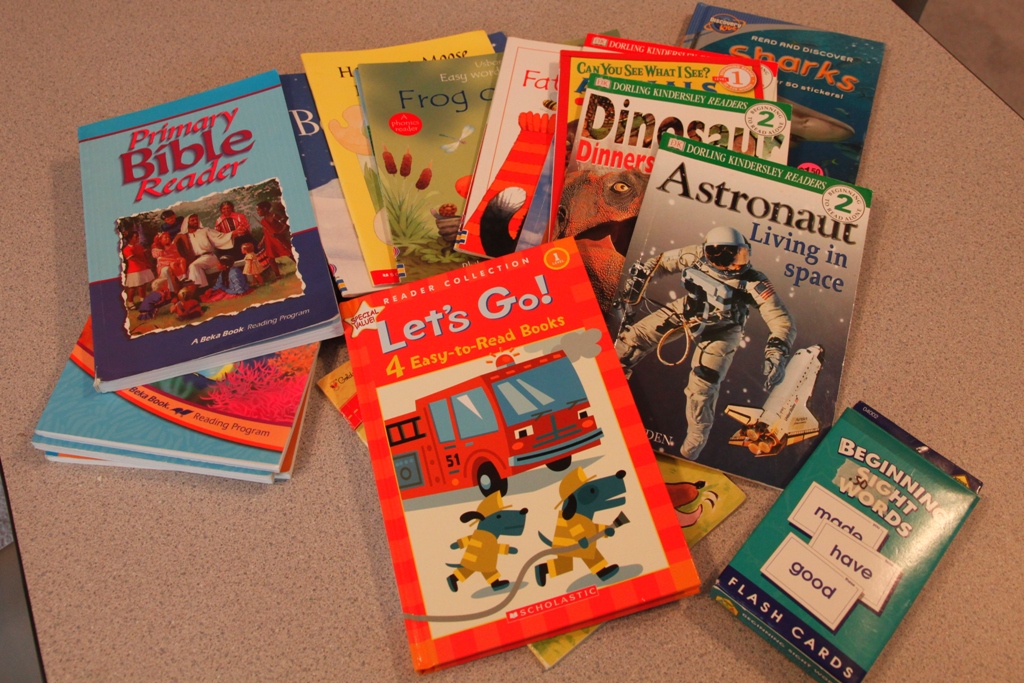
I will never fail to be amazed at the books I find at yard sales.  You will frequently find me sitting on the ground pouring over a box of children's books.  I've found everything from children's classics to readers and photo encyclopedias.  Most books are typically in remarkable conditions as well.  I always have to look carefully for books because I frequently find them stuffed in a box in a forgotten corner, banished from the goods deemed more exciting.
My lastest discoveries.  I must credit my neighbor, which is where I  found a number of these books during the community yard sale in my neighborhood.

Practical Life Supplies
Kitchen supplies are another category of items easily found at most yard sales.  Granted, these are generally not child sized but often there are some tools that are universal.  A garlic press is fun for squeezing water out of sponge.  Turkey basters are wonderful for water transfers.  This is where you can get creative and use your imagination as to how various gadgets could be used for isolating fine motor skills.  In the event that something doesn't work out like you hoped, you didn't pay much for it.  I still hope to stumble across a hand powered egg beater myself.  I did purchase a real silver spoon last year so the children could practice polishing it.

Another thing to be on the lookout for in the practical life area is small bowls for holding transfer materials.  You can never have too many little containers!  
  

Cultural Oddities
Resist the temptation to bypass the knickknack table.  I've been surprised at the number of gorgeous hand crafted items I found from various cultures mixed in with ordinary decorative items.  A few of my finds include hand painted metal trays from England, hand carved wooden bowls from Spain and a miniature glass pitcher that was hand blown in Romania.  I am always looking for more items to place in our continent boxes or to simply add diversity on the shelves.    


Furniture
Child sized furniture and shelving are relatively common finds during yard sale season.  Since these are larger purchases I recommend having a general idea of what you need ahead of time.  If you are in need of shelves, keep measurements of the intended area with you.  I also recommend carrying a tape measure to confirm a good fit.  One of my favorite tricks was re-purposing an old end table.  All I had to do was cut a hole out in the top and drop in a dish pan.  I had a fabulous sensory table for less than $5.  

Our new-to-us table and chairs.  This ranks as one of the best find I've made for the classroom so far. 

Gross Motor
I wholeheartedly agree with Montessori's assessment of a child's need for movement.  Gross motor develop is important.  I have setup an indoor gross motor area in addition to the standard outdoor fun and it has been critical on days that are too wet or cold to go outside.  I have come across a number of fun options such as climbers, slides, tunnels, bounce houses, rocking horses, ride-ons, scooters and mini trampolines.  An inflatable pool makes a fantastic ball pit and swings can be hung indoors.  Anything that encourages movement is fair game.


Storage
And last, but not least, don't forget to look for ways to store all of the fabulous stuff you are purchasing.  Tackle boxes and hardware organizers are great for organizing small items such as extra beads for math works.  Any type of caddy, organizer or drawer system can be useful.  Much like furniture, this is going to depend on what your specific needs are.  I suggest taking a quick peek at your school area, however you define it, each time you plan to shop yard sales so your storage and organizational needs are fresh in your mind.  And of course, focus on the problem because the perfect solution you stumble across may be something you never imagined.


I hope everyone has a fantastic yard-sale season.  I'd love to hear about your best finds so leave a comment.  I'll continue to chronicle my Friday yard sale adventures on the Grace and Green Pastures Facebook Page.

Storing Extra Materials

Tuesday, February 26, 2013 / No Comments
If there's one thing you learn very quickly when managing your Montessori home school it's that you can become overwhelmed with stuff in a heartbeat.  I find myself constantly purchasing work to keep ahead of the kids.  I also tend to rotate areas like the practical life shelves frequently.

Here are a few of the top lessons I've learned in storing extra materials.

1 - Ensure Your Core Materials Are Visible

When I first found myself with more than I could fit on my shelves I dealt with the issue in a standard fashion.  I purchased a number of plastic bins and groups all of my material together by area (math, sensorial, etc).  While it took care of the problem, I quickly forgot the detailed contents of each bin.  Reviewing the contents meant pulling out all the bins and digging through them.  I went so far as to write my materials on index cards.  While that may work for some people, I'm far more visually oriented.

I have since revised my system.  My father put large shelves in the storage closet.  I then purchased some medium sized open baskets.  They are large enough to hold several works but not so large that smaller items get buried.  So far it is working wonderfully.  I can easily open the closet and see everything.


It's hard to see from the picture but the shelves continue across the entire span of the closet.  I wasn't able to get a good picture of the items in the corners but I don't have any issue seeing them, especially during the day.


2 - Store Specialty Topic and Seasonal Items Together

As tempting as it is to keep items sorted strictly by subject area, I've had the most success by storing seasonal, holiday and specialty themes together.  Since I tend to go looking for these themes when needed, I haven't had the same issue with storing them out of sight.  I repurposed my original storage bins and now use them.  They are kept at the bottom of the closet.  I don't have them labeled but as an example, one holds Christmas items such as the mini tree/ornaments practical life activity.


3 - Keep the Items You Rotate Most Highly Accessible

In the early days, my shelf rotations could easily take an hour per week to accomplish.  I blame part of that on my extreme need to over manage things.  However, some of it was due to the difficulty in accessing the needed items, especially practical life material.  To help with this issue, I put several sets of plastic drawers in the adjacent closet.  And I apologize for the clutter.  This closet also houses what remains of our former office.


I realize it's hard to tell from the photo but this primarily contains practical life and small science items.  For example, I have one drawer that holds cleaning supplies such as brushes, polishing cloths and sponges.  Another drawer hold implements such as spoons, tongs and chop sticks.  My science drawers hold items like thermometers, magnets, prisms and a compass.  I keep small spoonables such as mini-pompoms in a drawer in baggies.


I have a good sized collection of bowls and such.  I have placed them in fabric bins at the top of the language shelves above my manuals.


Here is what the contents look like.


The other works that I need quick access to are the infant/toddler materials.  I tend to spend the work period plopping down various works for the little guy, hoping that something sticks.  For that purpose, I added a desk organizer to one of the extra desks.  I use it to hold infant items.  This prevents me from having to open the material closet while the kids are in there.  Now that all the materials are visible everyone scrambles to ask for their favorite!


There's a small glimpse into our storage solutions.  In the future I'll delve into other storage challenges such as books, cards (and cards upon cards), miniatures, worksheets and general teacher supplies.

Ideas for Valentines Day

Wednesday, February 6, 2013 / No Comments
Today on WWW Wednesday we will be taking a very short trip around the Internet.... to my own blog!

Last year I posted about our Valentine's Day activities.  As it turns out, there isn't much different on the agenda this year.  

The first post shows our Valentine count down chain as well as some of seasonal books we read this time of year.  We are doing both again this year.

The second post shows some of the Valentine related work on the shelves in the classroom.  This included a heart counting activity and a stickering work.  My favorite was the draw and cut your own heart tray.  I was amazed at how easy it was for the kids to follow the steps.  They were immensely proud of the results.

The final post details our activity from the day itself.  We made heart shaped salt dough ornaments.  My favorite activity was using paint and a laminated heart to tell the story of Jesus.  Elora still talks about it nearly a year later.  I will introduce it again this year.  However, this time I intend to leave it in the classroom for a few weeks.

There is one addition this year.  I found these adorable mailboxes at the store a few weeks ago.

My husband and I take turns writing special notes to each of the children.  They have greatly enjoyed reading their mail each day.  It has also been a wonderful opportunity for us to focus on the many lovely qualities our children posses.  I intend to save and date the notes.


What special activities or traditions do you have for Valentine's Day?

Yants!

Tuesday, July 10, 2012 / No Comments
Once again we have been plagued by little black sugar seeking ants.  The mild winter has led to an onslaught of invaders of record proportions.  I have been on a quest to find the safest method of discouraging the invaders.  Here are some of the tricks I've discovered.

Borax
Mix equal parts of borax and powdered sugar.  Sprinkle it on ant trails or fill a small jar lid with it.  The ants will take it back to the nest and eventually kill the queen.  While borax is safer than most chemical treatments, it is still best to keep it out of reach of kids and pets.

Pepperment Oil
Pepperment EO is great at covering up an ant scent trail.  I generally put a few drops at the entry point.  I have also used a drop or two to break up massive trails across the floor or wall.  It's best not to get this on your skin due to it's strength but the amount used is so small that it generally doesn't present an issue.  At least my children have never taken an interest in it!

Diatomaceous Earth
DE is my latest find and so far I love it.  Not only has it been effective at stopping the invasions but it is completely safe to eat, provided you purchase the food grade version.  In fact, when taken as a supplement it offers numerous health benefits.  It can't get much safer than that.  To use, simply sprinkle it along the ant trails.  It takes some time to work but it eventually does the job.

If you have any tips or tricks to add, please let me know!

Loving Little Boys

Wednesday, March 7, 2012 / No Comments
My sweet little William is growing up as well as growing into full toddler hood.  One of my favorite qualities about him is his intense passion for life.  Of course, sometimes this translates into some interesting moments.  These are a few of the posts I've stumbled upon in the last week that I've found helpful.

1 - I adore the toddler calm down ideas from Little Hearts Books.  The calm-me bottles are brilliant and they are on my project short list.  We have already cleared out an area on the main floor for our own comfort corner as well.  I found a tent tutorial from Cakies.  I'll post pictures once I have ours setup.

2 - Beautiful Sun Montessori posted a great technique for helping resolve conflict.  While I'm not sure that my little guy will fully understand it yet, we plan to implement this immediately.  I think the simple act of lovingly touching both children will go a long way to removing the tension.

3 - The post "I Let My Child Say No" at Blogher gave me some food for thought.  I've been trying to be more of "Yes" mom.  I see the next step as letting my child tell me no.  For some reason, hearing no from my child causes an immediate gut reaction.  This article reminded me that my children have their own wills.  Most of the time their "no" just means they don't want to do something, not that they want to defy me.

4 - And of course for the moments where you need to tell your child no, How We Montessori has a great post on how to say "No" the Montessori way.

5 -I want to end with a lovely little post by Team Studer called  25 Rule for Mothers of Sons.


I hope you enjoy them as well.  If you have any related articles, please share in the comments!

Velcro and Folder Works

Tuesday, March 6, 2012 / No Comments
In my post yesterday I showed Elora and William using some of the folder works such as picture matching and patterning.  One way that I've added interest to these works is by adding velcro.


I begin my setup as I would with any printed material.  I laminate and cut.  Then I attach the material to a blank file folder using glue dots.  I like the floral ones because they are thin rectangles and hold well.  This one if from Montessori Print Shop.


I then attach the velcro.  I prefer to put the softer side on the material attached to the folder.  In the past I have used strips and cut them into small squares.  Recently, velcro circles have dropped in price and they are my first pick.  All you have to do is peel and stick.

I store the working pieces in a small bag that I attach to the folder with a large paper clip.


Here is another example of a folder work.  The pieces are rather small.  The velcro ensures that they are not knocked out of place while the pattern is being built.  This is from Montessori for Everyone.


I use velcro liberally on toddler works.  William frustrates easily so this ensures everything stays put.  He also loves to hear the sound of the velcro ripping when he's finished.  This is from 1+1+1=1.


Of course velcro doesn't work on all materials, nor is it constantly necessary.  I got this Cat in the Hat visual discrimination work from Joyfully Weary.  I could have put the hats in a folder and left space below each one.  Instead I designed it as one large sheet.  Elora has to place each match carefully to prevent disturbing the other matches.


The folder/velcro setup can be useful whenever two sets of material are used.  For example, Elora found these opposites cards confusing at first.  I marked one item in each pair with a star which made it much easier to complete.  I also could have affixed one of each pair to a folder and left enough space for the corresponding card.


Hopefully that gives you an idea or two on how you can add some fun with velcro.  It adds a great point of interest and prevents the frustrations of accidentally shifting completed work.

Favorite Kindle Apps

Wednesday, February 29, 2012 / No Comments
Welcome to WWW Wednesday!

In the interest of full disclosure I will admit that I LOVE Amazon.com.  I have been shopping on the site since the late 90s.  I purchase a number of our household and grocery items there through subscribe and save.  We are Prime members and love the free videos.  And of course, I buy a wide range of school supplies there too.

My husband got a Kindle Fire for his birthday in December.  I instantly fell in love... madly, deeply in love.  I thought it was a simply a full color e-reader.  I had no idea it could do so much more.  My wonderful husband surprised me with my own Kindle Fire for Valentine's Day.  I was shocked and excited.  It has become instrumental in managing both the household and school.  I have no doubt that the more I use it, the more ways I'll find to integrate it.

I am very fortunate the I have most of my Montessori albums in electronic format so it was simple to move them to my Kindle.  I still need to refer to my binder from time to time when giving a lesson.  Using my Kindle is much less obtrusive.  I can also bookmark the lesson ahead of time or perform a quick search if I'm trying to find something on the fly.

What has really opened up the possibilities is the apps that are available.  So far there are three I find myself accessing every day.

Out of Milk - This application allows you to create to-do lists and shopping lists.  It is extremely easy to use.  You can create as many lists as you like as well as copy and backup your lists.  The biggest point that separates this app from other to-do list applications is that there is an online companion with the pro version.  This means I can manage my to-do lists from any web browser as well and sync this with my Kindle.  My husband has purchased the pro version of this app as well.  We are able to share our to-do lists with one another.  It's fun to put surprise items on his honey-do list.

CalenGoo - This application allows you to put your Google calendar on your Kindle.  You can use it offline and then sync it when a wifi connection is available.  I love having this available when out and about so I can schedule appointments directly on the device.  As with Out of Milk, we can access this via a computer or the Kindle.  My husband and I both share the calendar.  For the first time in history we have one family calendar!

gReader -  I adore reading other blogs.  Google reader is my go to blog reader of choice so it's no surprise that I love the app for the Kindle.  It puts all of my parenting and Montessori blogs right at my fingertips.  The interface is reminiscent of the traditional online experience.  And even better, the posts I read on my Kindle are marked as read everywhere.  If you enjoy a more magazine like experience for Google Reader, I also recommend trying Pulse, which comes preloaded on the Kindle Fire.


What applications have you found useful for organizing your household?  Perhaps I'll write about my kid's favorite apps in the future.

Our Unusual Light Table and School Week Wrap Up

Monday, February 27, 2012 / No Comments
Happy Monday!  Today I want to share a wonderful Craigslist find.  Many months ago I got the urge for a light table.  Instead, I found this for a whopping $10:


Yes, an overhead projector...  I wasn't sure how it would work out but overall, I'm thrilled. Not only does it offer the usual light table fun.


It also does this!   These are overhead projector pattern blocks projected on the dining room wall.


Elora found a lot of uses for the pattern blocks including making shapes and color mixing by overlapping pieces.  And yes, some of these pictures are older which is why she looks so young.


I introduced tesselations to Elora.  I started building a pattern and she wanted to finish it herself.


And here it is on the wall.


William has recently taken an interest in it as well.


Here Elora is trying to make shapes by watching her hands on the wall.


Another great find was overhead projector fraction circles.  


I even like the case for the circles.  She had to build each circle to put them away.


I bought a few transparency sheets so she could draw on them as well.


She liked watching herself.


I wrote her name and she copied it.  I was thrilled since she usually has no interest in writing.  We aren't certain but it's likely she has pain in her hands due to her arthritis.


She has had an intense interest in both geography and astronomy lately.  She decided to draw a map of planets.  She drew the houses that people live in as well.


We also have overhead letter tiles.  We played a game where I laid out several tiles to see if she could find the letter to spell her name.


She did it!


If you are interested in an overhead projector then I highly recommend checking Craigslist.  I purchased mine months ago but there still seems to be new listings every week.  I did a quick search and found two listings in our area for the past week alone, one which had several for sale at $20 each.  I'm not sure about all models but ours does not get hot.  There is an amazing amount of items designed for overhead projectors, most of which are fairly inexpensive.  I suggest visiting your local teacher supply store.

And of course we had our usual week of school activities.  Geography continues to be popular.  William really wanted to help with the flags which is why Japan has moved to South America.


Elora took an interest in the puzzle maps.  She had no problem completing the continents and could even identify a few.


She really wanted to work the North America map.  She needed my help to complete it but she enjoyed it.


She choose to explore the South America continent box.


She also completed a work I made for her.  We sorted items based on what needs electricity, batteries or doesn't require power.  We lost power for several hours a few weeks ago so she has had a lot of interest in this topic.  It also fits with our physical science work at the moment.


William is in a phase of repetition.  More towers, more sponge squeezing and more parallel lines.


He wanted to draw on the slate, which was a first for him.


I also caught him picking up a work he had accidentally knocked off the shelf without being asked.  I was very excited for him.  He's a bit of a tornado in the classroom sometimes, which is to be expected given his age.  I'm glad he's becoming a bit more gracious and concerned about the classroom.