Recent Posts

Menu
Powered by Blogger.

Browsing "Older Posts"

Browsing Category "Montessori"

Sensorial: Five Fun Facts

Saturday, May 16, 2015 / No Comments
Sensorial is a unique area of study in Montessori.  While it is true that it involves the senses, there are a number of fun facts about sensorial that may not be known as widely.


1.  It's Different Than Sensory
Sensory play and related activities are great ways to engage your young child's senses.  However, there is a slight distinction between sensory and Montessori Sensorial.  With sensory activities, a child is stimulating multiple senses at one time.  It is usually open ended and without a direct aim.

Montessori sensorial is designed to train individual senses.  The activities isolate one very specific concept to bring awareness to subtle changes.  For example, a sensory bin is a favorite for sensory play.  It allows a child to experience a number of items in a tactile way.  In the realm of Montessori sensorial, the tactile sense may be explored using the touch tables.  This is a set of matched wooden tables that each contain a different grade of sandpaper.  Children will work, often blindfolded, to match the pairs using only the tactile sense.  The changes between each tablet are subtle and can require great concentration.  The end result is that the child refines and deepens the tactile sense.


The iconic pink tower with every cube identical in shape a color - drawing attention to size.  

Now please don't take this to mean that sensory play doesn't have its place as well.  We certainly enjoy both here.  In fact, you can read about how I created our sensory table for $5.  At the same time, I encourage you to explore some traditional Montessori sensorial activities as well.


2.  Sensorial Is the Precursor to Math
While Sensorial is recognized for its immense value to the senses, it is often overlooked for its strong foundation in math and logic.  In fact, in a traditional scope and sequence, the math area is not explored until the child has a foundation in sensorial.  Maria Montessori designed nearly every traditional Montessori material with some mathematical aspect.  Many of the items are in sets of ten to reinforce the decimal system.  But it goes further than that.  Let's visit the pink power again.  Did you know that the perfectly portioned cubes also represent the cubes of 1 through 10 (1, 8, 27, 64... through 1000)?  This can also be an experience in volume since the largest cube is equal to exactly 1000 of the smallest.  And you thought they were just stacking blocks.  ;-)

And the list goes on.  The red rods introduce early counting while the binomial and trinomial cubes introduce algebraic equations.  Materials like the constructive triangles and geometric solids introduce early geometry concepts.  Sensorial is truly one of the best math foundations.


This is the decanomial square, a primary level sensorial work.  This brilliant material is a visual representation of the table of Pythagoras.  It is a representation of the multiplication tables with the cubes running diagonally.  As you can see in the second image, the pink tower cubes fit the cubes in the table perfectly.  And yes, a preschooler can create it.


3.  Sensorial is Only Found in the First Plane
While sensorial activities provide an incredible foundation for training the senses, early math concepts, and logic, these activities are unique to the first plane of development.  This is the plane that encompasses the absorbent mind, which spans from birth to age six.  You will find a brief summary of the planes here.  Maria Montessori found that this age range was specifically geared towards this area of work.  Of course, this doesn't mean you can't introduce some sensorial work to an older child.  But in a more traditional Montessori approach, the activities are altered for the next plane of development.

And that brings us to the next point.


4.  Many Sensorial Materials Extend to Elementary
While we may consider many of the traditional sensorial materials for preschool, many of the materials will actually be used far into Montessori elementary through age twelve.  You may even see a few used at the adolescence level!  I was pleasantly surprised to make this discovery early on, and it helped justify my decision to invest in several key pieces.  But while the materials haven't changed, the way they are used has.  During the first plane of development, the children are primarily using the materials as a way to refine the senses.  However, in the second plane, the same materials they have become familiar with are reintroduced anew to explore advanced concepts in mathematics and geometry.

One of my favorite examples of this concept is a TEDx Talk that shows how the binomial cube transitions through the various planes.  It is a great demonstration of the brilliance of a Montessori education.


5.  Easiest to Recreate
One of the best aspects of sensorial is that the core activities are amazingly easy to set up using items that you most likely already have at home.  Simply choose the sense you wish to work with, and provide an activity that isolates it.  For example, you can try tasting various flavored liquids, matching pairs of fabric by touch, smelling various spices. visually grading different sized pieces of paper with same color and shape, and listening to how different instruments sound.  And don't forgot some of the lesser considered options such as discerning color, weight, and temperature or using the stereognostic sense.  Truly, the options are limitless in this area.  If you are interested in the traditional sensorial activities, you can find presentations from both the AMI Primary Guide and Montessori Album.


I hope this helps give you a deeper understanding of Montessori Sensorial and inspires you to incorporate a few activities in your home.

-Bess
Don't forget to follow me on Facebook and join me at Montessori Homeschooling.


This post is part of the 12 Months of Montessori series.  I encourage you to visit each one to learn more about Sensorial.


Amazing blogs involved in the 12 Months of Montessori Learning

Edible Botany

Thursday, April 16, 2015 / No Comments


While we often stress the importance of eating our fruits and vegetables, how often do we ask our children to eat their roots and stems?

Learning the various parts of a plant may be a common lesson in a Montessori classroom.  However, what can help those lessons come to life more than exploring those parts with our taste buds?

For this activity, I began by collecting various edible plant parts.  Here is what I chose:
  • Flower:  Cauliflower
  • Fruit:  Tomato
  • Leaf:  Romaine Lettuce
  • Roots:  Carrots
  • Seeds:  Pumpkin Seeds
  • Stem:  Asparagus
     
I gave my children plant part cards so they could label each item.


They worked together and were able to label everything correctly.


Then came the fun part - trying each of the items.


While my children had eaten everything I presented before, the activity made them particularly eager to try them anew.  In fact, I couldn't get them to stop eating.  I intend to try this activity again in the near future and introduce some new foods they have not been interested in before. 


We used a plant part checklist to label each item.  We checked them off as we tried them.  And yes, one of my children decided to eat a tomato as if it were an apple.


The lesson quickly took on a practical life element as my children asked to cut the fruits and vegetables.


We practiced our knife skills and safety.


To highlight just how successful this activity was, my children spent over an hour cutting and tasting.  It culminated with their desire to make salads.  They acquired the proper dishware and proceeded to prep the veggies.  


Overall, the activity was a phenomenal success.  I haven't seen my children this engaged in something for a long time.  I was also surprised at how deeply it helped them connect the lesson to other fruits and vegetables.  It wasn't long before we were trying to identify as many sources of seeds as we could.  My son's face lit up as he proclaimed that by eating a tomato we were actually eating both a fruit and seeds.

If you would like to try this activity at home, I have a free printable available here.  It includes the plant part cards, journal pages for the tasting experience, and a tasting checklist.

Here are a few suggestions to try:
Flower:  Broccoli, Cauliflower, Artichoke, Squash Blossom
Fruit:  Bell Pepper, Tomato, Apple, Banana, Any Berry, Squash
Leaf:  Cabbage, Chard/Kale, Spinach, Cilantro, Parsley, Basil
Roots:  Carrot, Sweet Potato, Parsnip, Beet, Turnip, Radish
Seeds:  Peanuts, Sunflower, Pumpkin Seed, Lentils, Wheat Berries, Rice, Quinoa
Stem:  Asparagus, Onion, Celery, Cinnamon, Leek, Rhubarb

Happy tasting!
-Bess

Don't forget to follow me on Facebook and join me at Montessori Homeschooling.This post is part of the 12 Months of Montessori Series.  I am truly honored to be part of this endeavor.  Don't forget to visit all of the participating blogs to learn more about Botany.

Amazing blogs involved in the 12 Months of Montessori Learning


Mini Grammar Environments

Monday, March 16, 2015 / No Comments


If there's one thing all my children love, it's miniatures.  As a result, our collection of Toobs continues to grow.  I began to wonder how I could capitalize on my children's interest in all things small.

In a traditional Montessori scope and sequence, grammar is often explored through a material called the grammar farm.  It is a detailed model, complete with realistic animals.  Children experience grammar concepts by using sets of cards to label items within the farm; increasing the difficulty to full sentences with practice.

I was excited to discover that there were several farm themed Toobs I could use to recreate the grammar farm.  The smaller size was easier to manage and was far more budget friendly.  But as I put my farm set together, I wondered, "Why stop there?"  I subsequently began creating simple miniature environments for each of my children's favorite Toob sets.

 This ocean environment features the Coral Reef Toob by Safari Ltd.  It was very easy to create.


The box includes:
  • Toob Miniatures
  • Aquarium Plants
  • A Standard Blue Felt Square
  • Brown Felt Cut Freehand for Floor
  • Ocean Grammar Labels - See below to download for free

Children are free to explore the contents to create scenes.  


Before introducing the cards, review the names of everything in the box via the three period lesson.  

Once the various parts are known, introduce the noun cards (black outline).  If your child is a new reader, it may be helpful to simplify the noun set by removing more difficult words.


As your child progresses, you can begin to offer more words.  Here are a few examples of how the experience can progress over time.


It is not necessary to name the parts of speech.  In fact, it is often more meaningful to the child if they independently discover how the various color coded sets are used.  The cards have been color coded to match the Montessori Grammar Symbols.  An older child who has experience with that material will be able to make the correlation.

But the fun doesn't stop there!  Here is an example of our Musical Instruments mini environment.  I was able to purchase a full set of matching grammar cards from LDA Montessori.


As you can see, you can turn any Toob set into a miniature environment to help expand vocabulary and explore grammar.  I prefer to store each set in a small box so my children can choose.  However, if space is limited, you can rotate the available option.


-Bess

Don't forget to follow me on Facebook and join me at Montessori Homeschooling.


This post is part of the 12 Months of Montessori Series.  I am truly honored to be part of this endeavor.  Don't forget to visit all of the participating blogs to learn more about Language Arts.

Problematic Praise

Thursday, May 1, 2014 / No Comments
Praise and rewards have become a staple in the traditional classroom. Did you get an A on your test? Then you get a candy bar. If you read 15 books over the next 6 weeks then you get a pizza party. Get caught doing something good and you'll get a star on your chart. The barrage of behavior incentives don't stop in the classroom either. As parents, we brag, we praise endlessly and sometimes we even offer tangible rewards as well.

But what’s the harm? Clearly these tactics to modify behavior get a return. Once you find the external factor that influences a child, it can get incredible results.

Maria Montessori took a strong stand against rewards and meaningless praise and for good reason.  This approach teaches children to be extrinsically motivated and increasingly rely on external factors to drive them.

We want our children to become lifelong learners; to love reading. But earning prizes for these tasks creates the opposite effect. Why read for the love of it when you can read to get a day at a theme park? Why learn for the sake of curiosity when you can hear your parents gush about how smart you are? It’s a slippery slope - one I became all too accustomed to myself as I desperately sought the approval of any adult in a 50 mile radius.

If you still need more proof, let’s look at Generation Y, otherwise known as the “Me” generation. Arguably, this is the self-esteem generation. They were raised at the height of the praise and reward movement. The result? A generation that is labeled narcissistic and deemed difficult to motivate by employers. Sadly, we don’t ask ourselves what we did wrong. Instead, we try to find various external factors to blame. I would argue that we’ve created a generation that is still looking for their gold star. They simply don’t know how to find internal satisfaction because we’ve conditioned them otherwise.

What we really want our children to develop is intrinsic motivation. This can only occur in the paradigm that Montessori envisioned - one devoid of rewards and meaningless praise. In those instances, children learn to find internal satisfaction for their efforts. They read for the sake of reading. They treat others kindly because it’s what one should do. No longer is their joy robbed as they seek external approval. Intrinsic motivation transcends all stages of life. When they enter the adult life, they can be satisfied with a job well done.

While this all sounds great, I realize that the reality of removing meaningless praise and rewards is very difficult. Stay tuned, and next week I’ll give you some tips for implementing this in your home.

-Bess 

Two Simple Steps for Practical Life

Friday, March 21, 2014 / No Comments
On our last post, we talked about why the practical life shelves in my classroom as so small.  


Shredding Sweet Potatoes for Sweet Potatoes Brownies


As I mentioned there, practical life activities are very important for a child.  While I like to incorporate a few isolated activities or works that the children don't get to practice much in the classroom, I love to give as many real-life practical life experiences outside of the classroom as possible.


One of the best parts of incorporating everyday practical life is that it's so simple and doesn't require a large, specialized purchases.  In fact, you can most likely get started today with a little creativity.  In fact, there are only two things you really need:  accessibility and time.

We live in an adult-sized world and while we think of so many of our daily tasks as too difficult for children, the reality is that often accessibility is the true obstacle.  Children cannot sweep with adult-sized brooms, wash dishes at a sink they cannot reach or cut vegetables with a large knife.  When looking at any task, you must think about it from the perspective of a child.  Does the child have properly sized equipment?  Can the child gain access to everything they need to complete the task?  Is the child able to work comfortably?  It's also important to approach accessibility from a readiness standpoint.  While I think most young children can be taught to safely use a sharp knife, dull, plastic knives are a wiser choice for a beginner.

Washing Mushrooms from the Learning Tower

Slicing Mushrooms with a slicer

The final aspect can be particularly challenging.  Using practical life around your home takes time... lots and lots of time.  It takes time for your child to observe and learn a task.  It takes time for them to practice it.  And even after practice, it generally takes far more time to complete a task than an adult.  Unfortunately, our go-go-go society doesn't support this aspect.  Giving my children the time they need to be successful has been a colossal adjustment in my mindset.  Chances are, you'll find a few internal struggles here as well.  Giving your child the time they need to get dressed and care for themselves may mean being late.  Everywhere.  You.  Go.   Help with laundry and dinner prep and easily double or triple the time the job takes.  But, if we are willing to let go, our children will gain an immense gift.  There's nothing like seeing my children delight in a job well done.... even when dinner is an hour late.

Not the fastest or cleanest cookies ever made in my kitchen but someone was certainly excited to be involved.


Sweeping isn't quite effective yet but he loves trying.  He'll get better with practice.


Taking turns stirring pancake batter.

In case you need a few ideas, here are a few things my children love to do at an early age:

  • Vacuum with a mini shop vac
  • Wipe down walls and baseboards with baby wipes
  • Unload the dishwasher
  • Fold washcloths
  • Match socks
  • Scrub vegetables and fruit
  • Peel potatoes
  • Pour and stir anything
  • Wipe the table after meals
  • Cut soft foods with a plastic, disposable knife
  • Pour drinks
  • Serve themselves at dinner
  • Dress themselves
  • Use apple and egg slicers
  • Grate cheese (before our dairy allergy)
  • Squeeze juice
  • Spread butter, jelly, sunbutter, etc
  • Dust shelves
  • Feed/Water the cats
  • Plug cables into the computer (non-power, USB, etc)
  • Put stamps on envelopes
  • Water Plants
  • Wipe off filthy DVDs and CDs
  • Sweep with a mini broom
  • Dig holes for planting in the garden


Peeling potatoes

Scooping food onto his plate for dinner.

Squeezing lemons for lemonade.

And if you're curious as to what a full scope to practical life can look like (it varies per album) you can visit the AMI Primary Guide.


Now, if I can just teach someone to change diapers....


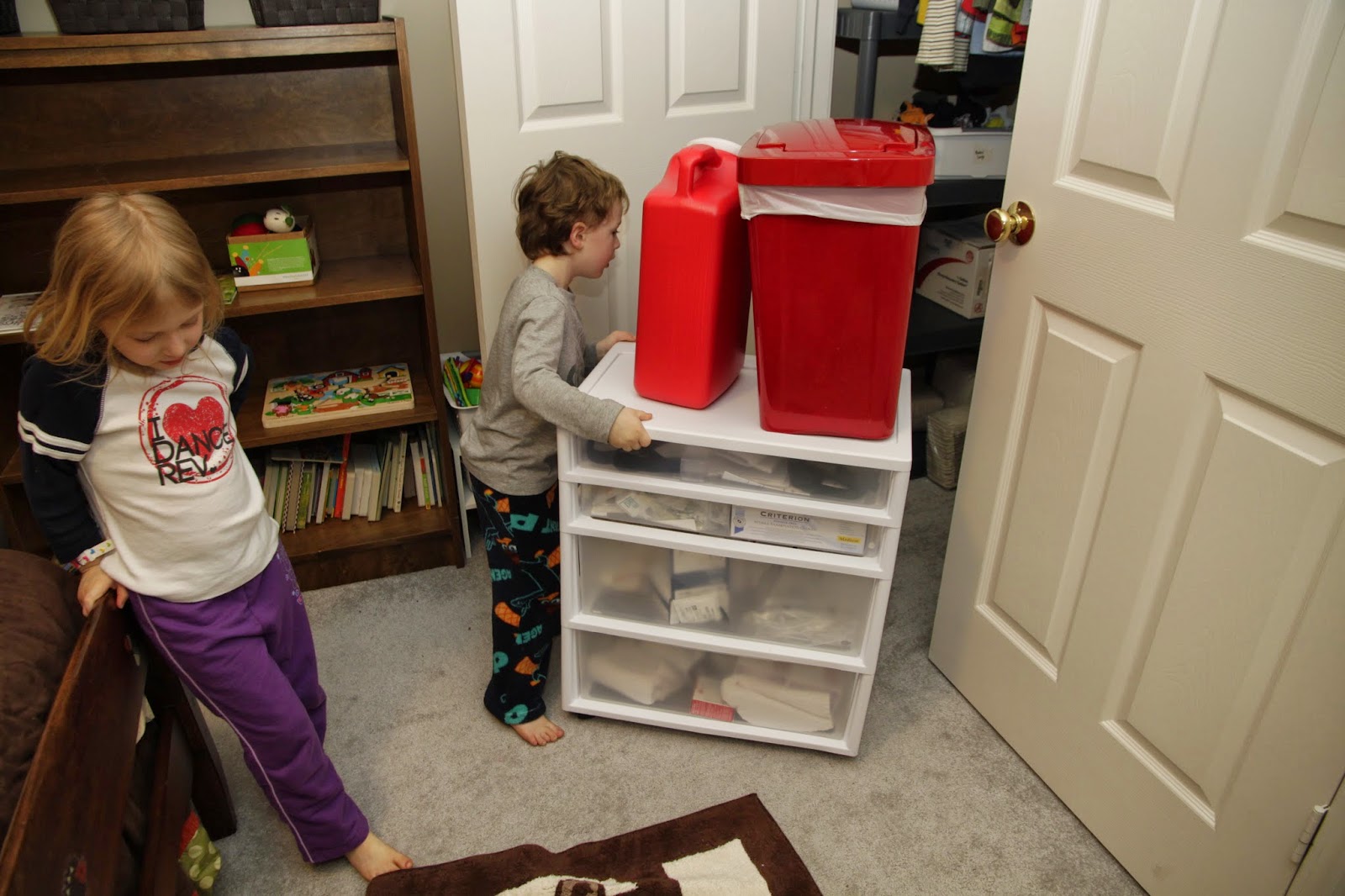
And just to see how relevant practical life become for our family at points, here are my children helping with a routine infusion for the little guy.  I've put the photos at the bottom just in case you'd like to skip it.

Preparing supplies after they washed up

Stretching the butterfly needle while daddy oversees

Opening the syringe and gauze

Helping push the factor.  Obviously, we stay in control for this step.

Putting away the supply cart.

Rethinking Practical Life

Thursday, March 13, 2014 / No Comments
Our Small, Often Neglected Practical Life Area

There's no denying the importance of practical life activities.  This area, unique to Montessori, teaches children coordination and fine motor skills through activities designed to care for the classroom environment and for themselves.  While tasks such as washing dishes, preparing food and sweeping floors are important skills to develop and foster greater independence for the child, they also help develop the muscles needed for writing and cognition.  If you have spent any time searching the Internet for examples of Montessori activities, chances are a lot of what you found fell into this category.

But if practical life is so essential, why have I chosen to keep this area of my classroom so minimal?

Maria Montessori saw practical life as a way to help children establish their place in society.  She found that children were most interested in those activities that replicated what they had witnessed as a part of life.  Her approach to practical life was just that - practical.  Children learned how to wash their hands, dress themselves, polish shoes, set a table, prepare and serve food, dust the shelves, sweep the floors, wash the tables and care for plants and animals.  All of these activities were relevant to the children's daily life in Italy during the early 1900s.

As I read about the history of Montessori and the purpose of practical life, I began to ask myself a few questions.  Are the practical life activities I'm presenting relevant to the time and place my children live?  Am I teaching them skills that will help them integrate into society?

While we're the type of Montessori family who has a dedicated classroom with traditional materials, I found that practical life belonged where life happened... everywhere.  It also revolutionized what I thought of as practical life.  While we work on sweeping with a broom, my children also have a child-sized vacuum (mini shop vac).  They help prepare aspects of dinner and serve themselves food and drink, even as young toddlers.  We practice dressing ourselves daily, and my oldest is learning to put a ponytail in her hair.  A wide range of adult activities can be adapted at a young age... unloading the dishwasher, sorting laundry, folding washrags, chopping vegetables, flipping pancakes, wiping up spills, sewing, raking, tending to the garden, wiping baseboards, scrubbing pots and washing windows.  That is practical life.

Granted, I still keep a few items on the shelves in the classroom.  My younger ones find themselves drawn to a work here or there.  However, my practical life shelves simply don't have the appeal that getting to do the "real deal" does.  My favorite aspect of classroom based practical life is when everyone pitches in to clean when we're finished.

I'm certainly not saying you're wrong if your activities are far less "practical" by definition.  We've done our fair share of tweezing colored pom-poms.  But if you've found yourself scrambling to keep your child interested, this could be a big piece of the puzzle.   Either way, I hope you will begin to see a wider world of possibilities for practical life.


Stay tuned as I share the two simple keys to making your home practical life friendly.

As always, I love hearing from you.  Track Grace and Green Pastures down on Facebook and don't forget to join our Facebook Group Montessori Homeschooling.  We've had some incredible discussions lately!

Bess

Our Montessori Journey

Thursday, January 2, 2014 / No Comments
My last post, Mapping Your Montessori Journey, addressed three questions to ask yourself to help determine what direction your journey should take. Since you've had some time to think about your answers, I thought it was only fair that I shared my story. I have started by simply answering the questions for those who would like the short version. If anyone is interested in our full, and very long, story, it precedes my answers.

How long do you plan to school at home?
Through high school, provided I do not completely lose my mind at some point. :-)

What are your academic goals?
My goal is to stick fairly close to the traditional approach, especially for the more academic pursuits. We certainly haven't applied every principle around our home but we also don't feel that each and every one would work for us.

How much of the traditional Montessori approach do you intend to utilize?
My husband and I both come from fairly strong academic backgrounds so classical academics do rank fairly high with us. We hope that each of our children will have excellent reading and grammar skills with a strong background in logical/critical thinking. Mathematics is also very important. We feel that a child that can read and reason well is equipped to learn for a lifetime. And of course the Classical educator in each of us desires a solid understanding of the arts (music, fine arts), history, geography and all things STEM related (science, technology, engineering, math). On the early part of our journey, we plan to focus primarily on the Montessori Method with a slight bent towards classical education. As our children age and Montessori trends towards more abstract concepts and independent research, we will most likely shift more and more towards a classical model.

The Full Story
My journey with Montessori began 6 years ago when I was pregnant with my first child. At the time, I intended to return to work part time after her birth. I began investigating various types of educational day care facilities. One summary I stumbled across mentioned Montessori. I was quickly intrigued and began reading up on the topic. It clicked with me immediately. I adored the hands-on, self-directed approach. Not only was I taken by the philosophy but I was captivated by the materials. I found the math material particularly intriguing. My excitement only double when I introduced the idea to my husband and he shared my enthusiasm.

We began searching for a school. While there were two nearby at the time, only one took infants and only older ones at that. It was a great school but they only offered a five day per week program. I had no intention of sending her away the entire week, especially since I was only working part time. I wanted a good amount of time with her all to myself.

As she neared her first birthday, I entered what I will call my "playing with Montessori" period. We setup two small shelves in the corner of our office and filled it with Montessori inspired wooden toys. I continued to read about the principles and even purchased some simple Montessori albums. But for the most part, I only approached it from the academic standpoint and loosely at that. The full philosophy certainly hadn't infiltrated our home.

I always assumed we would send our children to a Montessori school when they turned three. While I liked the ideas of Montessori, it was simply too much for me to sort through. I also didn't want to invest in a classroom or other comparable materials. I know my husband was secretly, or maybe quite obviously, hoping I would change my mind and stay home but I enjoyed my job. It was rocky but I pushed through and before we knew it, out second child was on the way. Shortly after his birth our lives were in for a dramatic change. Our oldest daughter was hospitalized with as sudden onset of high fever and knee swelling. Before long we found ourselves with a diagnosis of juvenile arthritis and uveitis.

The next year was a whirlwind as we focused our energies on trying to control her JA. We approached things both holistically as well as through traditional channels. Her energy and ability to move freely was gone overnight. We were also in a serious battle for her eyesight given the aggressive nature of her uveitis. If you can name it, we probably tried it. I had very little energy left to put towards, well, anything. And of course, it was this development that ended my career for good.

The medical bills coupled with the lack of income put full time Montessori schools fairly far out of reach. I was more comfortable having her at home anyway due to her needs and limitations. Both my husband and I still felt very strongly about the Montessori Method. We agreed that the best approach was to invest in creating a Montessori environment at home and to ensure I was at least modestly equipped.

What followed next was a whirlwind of searching for albums and guidance. I eventually settled on the set from KHT Montessori which included a 2 year online course. I also took educational courses from local schools. I took an intro course from one and a full para-professional training series from another. I slowly worked my way through my materials list and placed a very large supply order. All the while, I tried to wrap my head around how to translate Montessori into a home environment. Even though this occurred just a few years ago, there were far fewer online resources dedicated to the topic.

We approached primary head on. There were good days but there were really hard days too. I often wondered what I was doing, not that I felt I had many other viable choices at the time. I learned so much about myself in the process; primary that I possessed very little patience. I was gaining head knowledge every days and in fact, I had a fairly good grasp of topics such as presenting materials and scope and sequence. However, applying that knowledge was far more difficult than I imagined.

I had hoped to start a local Montessori co-op but had difficulty locating interested families. I was disappointed that my children were missing out on the community aspect of the Montessori classroom. We made a decision to send our children to the summer program at a local Montessori school; one which was wonderful in working with her treatment. Thanks to the help of family and my husband's willingness to work a few extra hours, we've been able to send our daughter for three straight summers and my son for two. It's been such an enriching experience. It also gives me some time in the summers to think and plan.

The last year or two have been fairly straight forward. That is, outside of having our third child who was diagnosed with severe hemophilia and multiple life-threatening food allergies. But hey, it certainly reaffirmed our plan to home school! Thankfully, school could practically run on auto-pilot by that point. I was constantly playing with shelf placement, schedules, planning and tracking but the overall gist was the same.

Our past school year was bit momentous. Our oldest was eligible for kindergarten. Skipping registration was a bit odd as it always stuck out in my mind as a rite of passage. She was doing great with our arrangement at home but it still felt odd to go against the grain. It's the first time it felt real and I'll admit that the pressure I felt increased dramatically.

As much as I loved our albums, I began to feel like I wanted a bit more organization with subjects like history and science. I also wanted to feel like I had a general grasp of where we would eventually end up some day; mainly a loose road map to high school. While Montessori can be used at those levels, it's exceptionally difficult to locate resources. Also, as Montessori trends from concrete concepts to abstract, it tends to line up with a broader range of educational options. For this reason, we decided to add a program called Classical Conversations to mix.

At the early levels, Classical Conversations is designed to give a backbone of key subjects, although those topics can be explored by any method you choose. Language arts and mathematics are left completely up to the parents. We are only one semester into the experience but it has been a great fit so far. I use the weekly topics to guide what we focus on and to help spark interest. For the most part, our work periods have stayed true to a more traditional Montessori approach.

Since this is my daughter's kindergarten year, it also means it is her last year of primary. Elementary is on the horizon and I'll readily admit that I am completely unprepared and overwhelmed at the idea. There are far less resources available than primary. I have chosen Keys to the Universe for my albums. Much like KHT, the Keys program offers an online support forum. I'm going to need it! I think the biggest challenge that lies ahead is tying up our primary work. When children work at their own pace, they don't necessarily reach "the end" with every subject at the same time. And of course, as she embarks on a new adventure I have one who is entering meatier years of primary and one who is just beginning. It's never a dull moment, that's for sure.

So that's where we are in a nutshell. While I think I know where we're going in the coming years, I'm sure the reality will be even more interesting.

Maria Monday - The Absorbent Mind Chapters 1-3

Monday, October 14, 2013 / No Comments
Today marks the first week of our Montessori Book Club.  We have read through chapters 1-3 of The Absorbent Mind.

For those unfamiliar with the works of Maria Montessori, they can be a challenging read.  Montessori writings echo the doctor and scientist that she was.  Not only that but her works were written decades ago in her native Italian.  Even the most recommended translations can take time to digest.  It's still very much worth your time to read.

After reading the first three chapters, I was struck by the similarities in the challenges facing the current system of education.  The issues and misconceptions she discusses are still highly relevant; perhaps even more so today.  I felt tinge of sadness at the reality that we've learned so little as a society despite the works and pleadings of numerous brilliant educators.     

Here are my brief thoughts chapter by chapter:

Chapter 1
Montessori addresses the fact that children are not empty minds just waiting to be taught and filled by adults. They are more than capable of developing themselves and in fact, learn unconsciously during the early years.

“We find ourselves confronted by a being no longer to be thought of as helpless, like a receptive void waiting to be filled with out wisdom”


Chapter 2
The second chapter addresses the need for learning to be a life long process encompassing all aspects of the individual.  We have separated the academic system from real life.

“In most state controlled systems, what matters is that the programme shall be fulfilled.”

“The world of education is like an island where people, cut off from the world, are prepared for life by exclusion from it.”


Chapter 3
The third chapter addresses the periods of development from a high level.  It points out the fact that current educational practices do not line up with the needs of the individual at each stage of development.  It misses the essential first six years altogether.

“Only practical work and experience leads the young to maturity.”

“Our work as adults does not consist in teaching, but in helping the infant mind in its work of development.”


If you'd like to delve deeper into this topic, join us for our book club discussion at Montessori Homeschooling.  It isn't too late to join in either!

Happy Reading!
-Bess

Montessori Book Club - The Absorbent Mind Schedule

Sunday, October 6, 2013 / No Comments
Our Montessori Book Club begins tomorrow!  I hope you're excited.  If you are new to reading the works of Maria Montessori, I want to encourage you to hang in there.  It is written from the perspective of a scientist.  There is a lot to take in.

The schedule is posted below.  We will keep it at three chapters per week which will allow us to finish by the end of the year.  Most chapters are 10 pages or less so it should keep the weekly reading requirements manageable.  We will discuss what we've read the following Monday at our online community on Facebook.  Don't forget to join us there if you wish to participate.  Our first discussion of chapters 1, 2 and 3 will take place on Monday, October 14th.

Week of:  October 7th  Read Chapters 1, 2 and 3

Week of:  October 14th  Read Chapters 4, 5 and 6
                Maria Monday Discussion of Chapters 1, 2 and 3

Week of:  October 21st  Read Chapters 7, 8 and 9
                Maria Monday Discussion of Chapters 4, 5 and 6

Week of:  October 28th  Read Chapters 10, 11 and 12
Maria Monday Discussion of Chapters 7, 8 and 9

Week of:  November 4th  Read Chapters 13, 14 and 15
                Maria Monday Discussion of Chapters 10, 11 and 12

Week of:  November 11th  Read Chapters 16, 17 and 18
                Maria Monday Discussion of Chapters 13, 14 and 15

Week of:  November 18th Read Chapters 19, 20 and 21
Maria Monday Discussion of Chapters 16, 17 and 18

Week of:  November 25th  Read Chapter 22 (Light Due to Holiday)
Maria Monday Discussion of Chapters 19, 20 and 21

Week of:  December 2nd  Read Chapters 23, 24 and 25
Maria Monday Discussion of Chapter 22

Week of:  December 9th  Read Chapters 26, 27 and 28
Maria Monday Discussion of Chapters 23, 24 and 25

Week of:  December 16th  Catch Up on Reading!
Maria Monday Discussion of Chapters 26, 27 and 28        

Discussion will be on Friday December 20th Due to Holidays


And please keep in mind that not all available editions are translated correctly.  Unfortunately, a number of the free versions of The Absorbent Mind have been poorly translated.  Obviously, if budget is an issue then simply acquire whatever copy you can.  The 1995 Holt/Owl Books reprint is one of the easiest to acquire.

I have the listed the correct chapters below so you can compare your edition.

1 The Child's Part in World Reconstruction
2 Education for Life
3 The Periods of Growth
4 The New Path
5 The Miracle of Creation
6 Embryology and Behavior
7 The Spiritual Embryo
8 The Child's Conquest of Independence
9 The First Days of Life
10 Some Thoughts on Language
11 How Language Calls to the Child
12 The Effect of Obstacles on Development
13 The Importance of Movement in General Development
14 Intelligence and the Hand
15 Development and Imitation
16 From Unconscious Creator to Conscious Worker
17 Further Elaboration Through Culture and Imagination
18 Character and Its Defects in Childhood
19 The Child's Contribution to Society—Normalization
20 Character Building Is the Child's Own Achievement
21 Children's Possessiveness and Its Transformations
22 Social Development
23 Cohesion in the Social Unit
24 Mistakes and Their Correction
25 The Three Levels of Obedience
26 Discipline and the Teacher
27 The Teacher's Preparation
28 Love and Its Source—the Child

Happy Reading!!!
-Bess

Maria Montessori Book Club

Sunday, September 29, 2013 / No Comments
There's no better way to expand your insight of the Montessori Method than to read the works of Maria Montessori herself.  In an effort to challenge myself and promote Montessori, I would like to create a Montessori book club.

I realize that most of us, including myself, have little time for heavy reading, so I intend to keep things reasonable.  I also want to provide enough time to really absorb the material.  My preferred pace is two to three chapters per week.

I would also like to have a check-in each Monday where we can discuss what we've read and encourage each other to apply what we've learned.  I'm also interested to hear how others interpret the material.

Anyone is welcome to join me.  I would like to begin reading on October 7th.  Our first "Maria Monday" online discussion will be on October 14th.  We will hold discussions on our online community on Facebook.  Don't forget to join Montessori Homeschooling if you wish to participate!  My goal is to complete our first book by the end of the year.

So what should we start with?
Our first selection will be The Absorbent Mind.  This is a great overview of the Montessori Method.  Its focus is primarily on the 0-3 age group, although the foundational principles are relevant to anyone interested in Montessori.

If you wish to join us, you have one week to acquire a copy.  There are places online where you can get one for free.  However, I highly recommend finding a copy from Owl Books or the Clio Collection.  I have seen numerous complaints about other versions being poor translations or leaving important information out.  Keep in mind that Maria Montessori's works were written a century ago in Italian.  The translation IS important.  Of course, if your budget is limited, go with whatever you can get your hands on.

I hope you will join us over at Montessori Homeschooling.  I'm excited to learn with you!
-Bess

Reworking the Work Plan

Friday, September 27, 2013 / No Comments
Marking items complete
I decided to introduce a work plan concept for Elora even though she is technically still in primary (more about that here).  Like any new venture, it's a process of trial and error.

Overall, I'm pleased with our new addition.  The kids love it.  It has helped me ensure we are making progress in key areas.  For some reason, having it listed on the plan is far more motivation for selecting a work than my power of suggestion.  My skills as a directress are clearly lacking, although I'm sure the mom/directress dual role adds a bit of confusion.

Six week ago my first attempt at a work plan resulted in this:


As you can see, my biggest focus was on math, reading and writing.  While I have three works listed for each area, longer works would count as 2 or 3.  This was especially true with the more involved math activities.

And just to clarify, my goal with the work plan was to encompass about 1/3 of a three hour work period.  I still intend to offer an ample chunk of free selection time.  I also still give extra presentations throughout the week according to the schedule listed here.  At least, that's the goal.

While I felt I was 80% of the way there, I realized that the plans were too focused on the three basics.  Yes, I am presenting new geography and science work each week but I also want to ensure those items we've covered in the past were being reviewed for mastery.

So the work plan now looks like this:

The abbreviations stand for geography/logic work and practical life/sensorial.
I ended up cutting the math, reading and writing back to two works per day.  Obviously, she can do more if she chooses.  I also added one science, one geography or logic, one practical life or sensorial and an "other" category in case there is anything else that is important for the day.

While I would love to complete each column every day, it isn't always going to happen.  Our work plan is a daily guide.  I never intend for it to become a measure of daily success.


Another major change is that I am no longer filling in the work plan ahead of time.  I now allow them to choose the work they would like to do from each area.  It has turned out better than I imaged.  It provides enough structure to keep the day from being overwhelming by helping to focus choice while still allowing each child to direct his or her learning experience.  To ensure I keep us on track, I still write out general ideas for work plans each week.  Then I know what to suggest and when to introduce something new.


I'm sure the next thing you would like to know is what actually goes in each box.  In the next week or two, I will share what a completed plan looks like for both Elora and William.

Three New Additions to Our Classroom

Friday, September 20, 2013 / No Comments
While we generally make purchases for the classroom twice a year, there have been some circumstances that have allowed us to add a few new items.

The first item is a complete splurge that my wonderful husband insisted on...  a mobile of the solar system.  This set can be found here.  I love, love, love this addition.  Astronomy is a critical subject for us.

There are no pictures I can take that will do it justice.

The various rods allow it to rotate gently.  It's a full four feet across.

Each planet has a photo-realistic surface which I have decimated due to my poor photography skills.

The next thing I received this week was a collection of dice.  I have a similar set of smaller dice, but Elora has a hard time reading them.  These are much larger and should be easier to read.   I ordered several sets so we could use them for addition.  I also ordered alphabet and continent dice.  I'm not sure what I'll do with them yet, but I'll think of something.

The set includes jumbo place-value dice (unit, tens, hundreds, thousands), continent dice and alphabet dice.  The seller included several number dice as a bonus.
If you're interested in obtaining you own set, check with jspassnthru on eBay.  The selection was great, and the delivery was exceptionally fast.


The die on the left is average sized.  Here you can see how large the jumbo size is.

Another item I ordered recently is the blends and digraphs set from Lakeshore Learning.  Lakeshore can be pricey, so NEVER purchase there without finding an online coupon code. 

The Blends and Digraphs Tubs in the original box.

Yes, you have to put everything together yourself.

Here are all the miniatures before being sorted into tubs.

All the tubs have been labeled and sorted.  The process took around 15 minutes.

This is the GL tub.  It include glue, glitter, globe, glove and glasses.

I absolutely adore the miniatures that come with Lakeshore Learning products.  The quality is generally higher than other miniatures.  They are typically a bit larger too.  Here are the glasses being held by William.

I'm excited to put the new items to use this week.  Be on the lookout as I'm sure they will grace our weekly work.

Have you recently added anything exciting?  If so, please post a comment!